
⚙️ AI-Ready Engineer Day 6 — Which RAG Framework Should You Use?
LangChain vs LlamaIndex vs Haystack

You’ve understood what RAG is. You’ve seen the pipeline.
Now it’s time to build.
But with so many tools out there — which one should you actually pick?
Let’s compare the top 3 RAG frameworks being used in enterprise and open-source circles:
🧱 1. LangChain
🧠 Best For: Developers who want control and flexibility
🔌 Works With: OpenAI, Azure OpenAI, Google Vertex AI, Hugging Face
💡 Highlights:
Highly modular — combine tools, agents, memory
Works well with vector DBs (Pinecone, FAISS, Chroma)
Large ecosystem + fast-moving
⚠️ Watch out: Can feel too complex for simple use cases
📚 2. LlamaIndex
🧠 Best For: Data folks who want to connect data to LLMs easily
📂 Works With: CSV, SQL, PDFs, Pandas, JSON, Notion, Google Drive
💡 Highlights:
Built for RAG from day one
Auto-indexing, retrievers, and prompts are simple to manage
Works well with both local & remote LLMs
⚠️ Watch out: Less "agent" support compared to LangChain
🧪 3. Haystack
🧠 Best For: Building production-grade RAG apps in Python
🏭 Works With: Elasticsearch, OpenSearch, Hugging Face
💡 Highlights:
Powerful pipeline system for search & QA
UI components for chatbot building
Can be deployed in Docker easily
⚠️ Watch out: More dev-heavy, best suited for teams
🧠 TL;DR – My Advice:
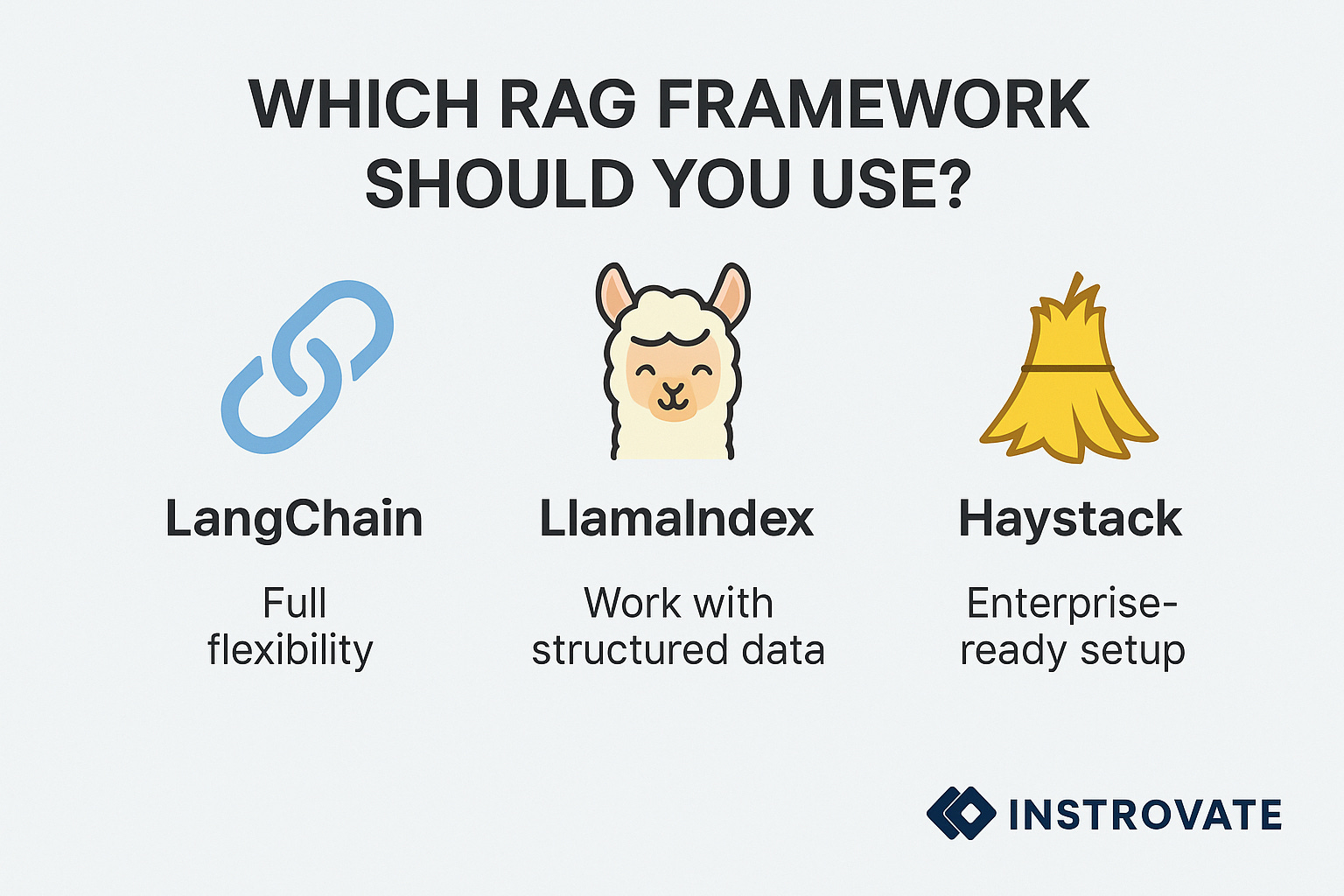
Use CaseGo WithYou want full flexibilityLangChainYou work with structured dataLlamaIndexYou want enterprise-ready setupHaystack
Tomorrow, we pick one and build a mini RAG app together.
No theory — just a working example.
👉 Subscribe to follow the build →